Pyhalofit example notebook
import numpy as np
import matplotlib.pyplot as plt
import pyhalofit
# loading precomputed power spectrum and cosmological parameters
k, pklin = np.loadtxt('data/kpk.txt', unpack=True)
cparam = dict(zip(['Omega_de0', 'Omega_K0', 'w0', 'wa', 'h'], np.loadtxt('data/cparam.txt')))
z = np.loadtxt('data/z.txt')

print('cparam   : ', cparam)
print('redshift : ', z)

plt.figure()
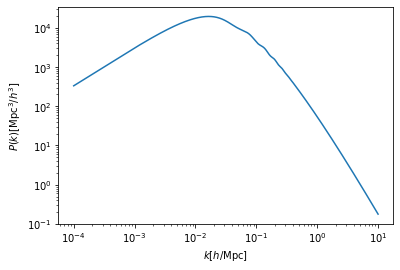
plt.xlabel(r'$k[h/{\rm Mpc}]$')
plt.ylabel(r'$P(k)[{\rm Mpc}^3/h^3]$')
plt.loglog(k,pklin)
plt.show()
cparam   :  {'Omega_de0': 0.6844, 'Omega_K0': 0.0, 'w0': -1.0, 'wa': 0.0, 'h': 0.67}
redshift :  0.251
Basic usage of pyhalofit
hf = pyhalofit.halofit() # make instance
hf.set_cosmology(cparam) # input cosmological parameter with dict
hf.set_pklin(k, pklin, z) # input k, power, and redshift
pkhalo = hf.get_pkhalo() # obtain halofit
plt.figure()
plt.xlabel(r'$k[h/{\rm Mpc}]$')
plt.ylabel(r'$P(k)[{\rm Mpc}^3/h^3]$')
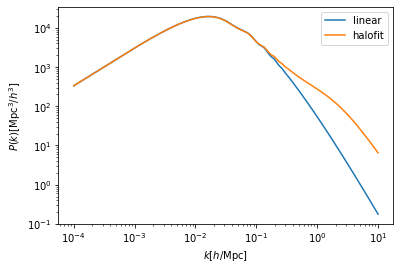
plt.loglog(k,pklin , label='linear')
plt.loglog(k,pkhalo, label='halofit')
plt.legend()
plt.show()
Tips
# obtain cosmological current paramter dict
hf.get_cosmology()
{'Omega_de0': 0.6844, 'Omega_K0': 0.0, 'w0': -1.0, 'wa': 0.0, 'h': 0.67}